
An Orange County PPF shop raised its monthly net profit by 25% in six months after switching its main film to HIGHCOOL, from $14,400 to $18,000 a month. Most of the gain came from material cost. The rest came from shorter installs and fewer warranty claims. The shop and owner names below are changed to protect the customer's data; the numbers are the shop's own.
The shop and the problem
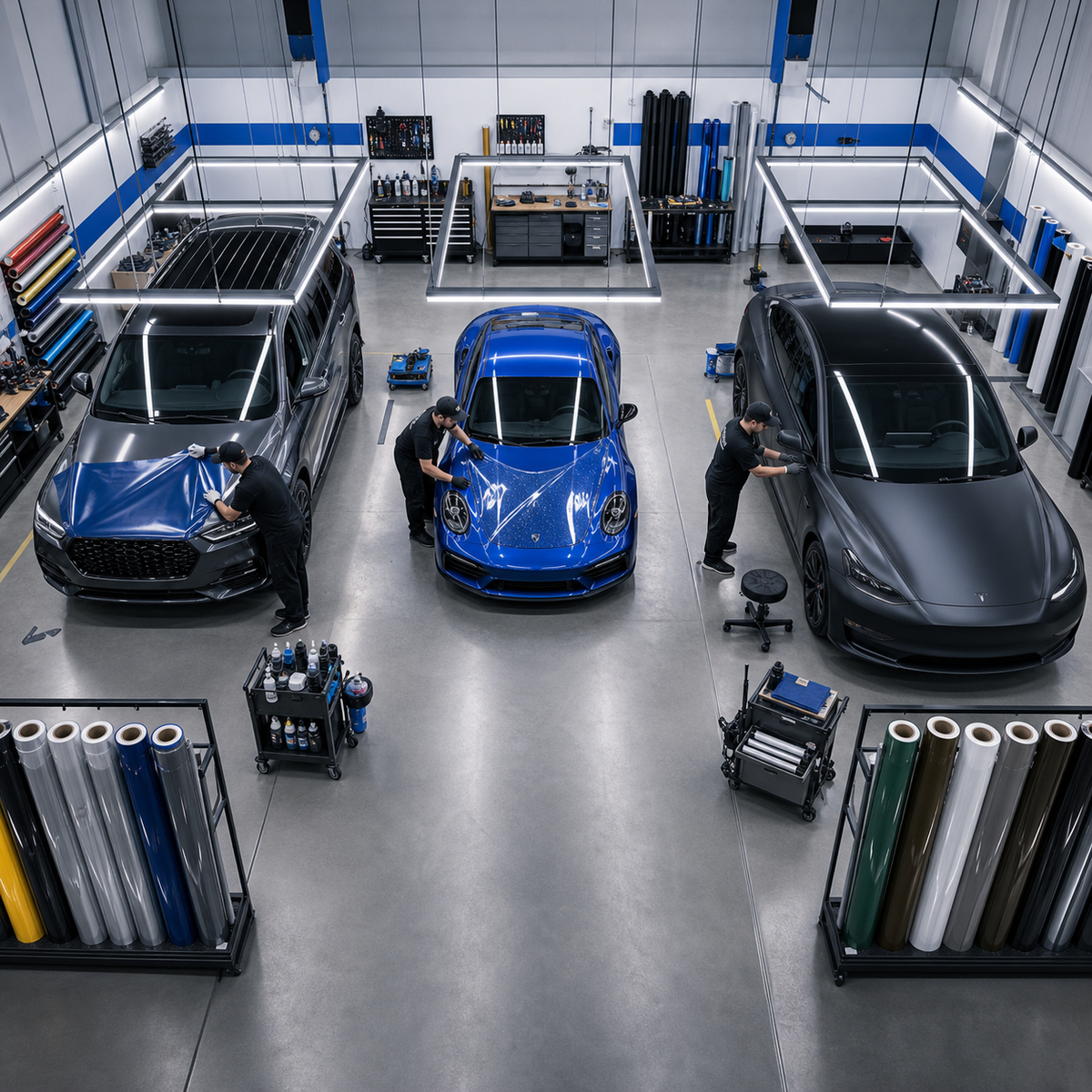
We will call the shop Elite Auto Shield and the owner Mark. The shop wraps 12 to 15 cars a month, mostly Teslas and high-end SUVs. Mark had stayed with one well-known PPF brand for three years. Revenue was at a record, and net profit kept shrinking.
He traced it to three costs. He was paying for the brand name on every roll. The brand program charged monthly software fees that added up to thousands a year. And its purchase rules pushed him into bulk orders, so cash sat on the shelf in slow-moving rolls.
The trial
Mark did not switch overnight. He ran a 30-day trial of HIGHCOOL PPF on real customer cars, watching three things: what the film cost him, how fast his crew could lay it, and whether he could sell the warranty as easily as before. Buying factory-direct cut his cost per roll by 35%. On a full wrap, film and waste came in a little over a third lower than with the old brand, and that difference stayed with the shop on every car.
His lead installer liked the tack. The film positioned and slid more easily on complex bumpers such as the Tesla Model 3 front, and full-body wraps went about 45 minutes faster on average. Across 15 cars a month that is roughly 11 labor hours, enough to fit one more car into the schedule without hiring.
Six months of numbers
Mark tracked the same figures for six months after the switch. The labor line is his monthly average per wrap, so it rounds the time saved to about an hour.
| Metric | Before (previous brand) | After (HIGHCOOL) | Change |
|---|---|---|---|
| Material cost, monthly average | baseline | about a third lower | -35.7% |
| Labor hours per wrap | 18 | 17 | -5.5% |
| Monthly net profit | $14,400 | $18,000 | +25% |
| Customer warranty claims | 1.5% | under 0.5% | about -66% |
The warranty claim rate is the number we would watch longest. Six months is a short window for film, and claims tend to show up in the second and third summers.
What his customers asked about
Mark expected pushback on the brand name. It mostly did not come. His customers asked about clarity, how water beads off the film and what the warranty covers. The grade he moved to carries a 10-year warranty against film defects such as yellowing, staining and hydrolysis, which let him keep offering the same term he had before. After six months of Southern California sun, the cars he had wrapped showed no yellowing and no loss of gloss. That is a good early sign, not proof of ten years.
He put part of the extra profit into new shop lighting and a floor coating, which helps the next install as much as the bank balance.
What this means for your shop
None of this was luck. Mark knew his cost per car before the trial and measured it after. The same check works for any shop: put your film cost per full wrap, your install hours and your claim rate next to a trial film, and switch only if the numbers say so. Your figures will differ with your volume and mix.
The shelf problem has a simpler fix. HIGHCOOL keeps 13 PPF SKUs in a US warehouse and accepts one-roll orders, so you do not have to buy ahead to get a good price. PPF A4 samples are free from our US sample stock; you pay shipping. To run your own trial, see the grades on our Paint Protection Film (PPF) page and send us your monthly volume through the contact page.
FAQ
How much did the shop save per car?
Film and waste per full wrap dropped by roughly 35% after the switch, in line with the 35% lower cost per roll. Monthly material spend fell by 35.7%.
Is this a real customer?
Yes. The numbers come from the shop's own six months of tracking. The shop name and the owner's name are changed to protect the customer's data.
Do I need to buy in bulk to try HIGHCOOL PPF?
No. We accept one-roll orders, and 13 PPF SKUs are stocked in our US warehouse. You can start with free A4 samples, paying only the shipping, before you order a roll.

Share:
Installing PPF on Complex Curves: A Step-by-Step Guide for Installers
HIGHCOOL TPU in Harsh US Climates: What Shops Should Check