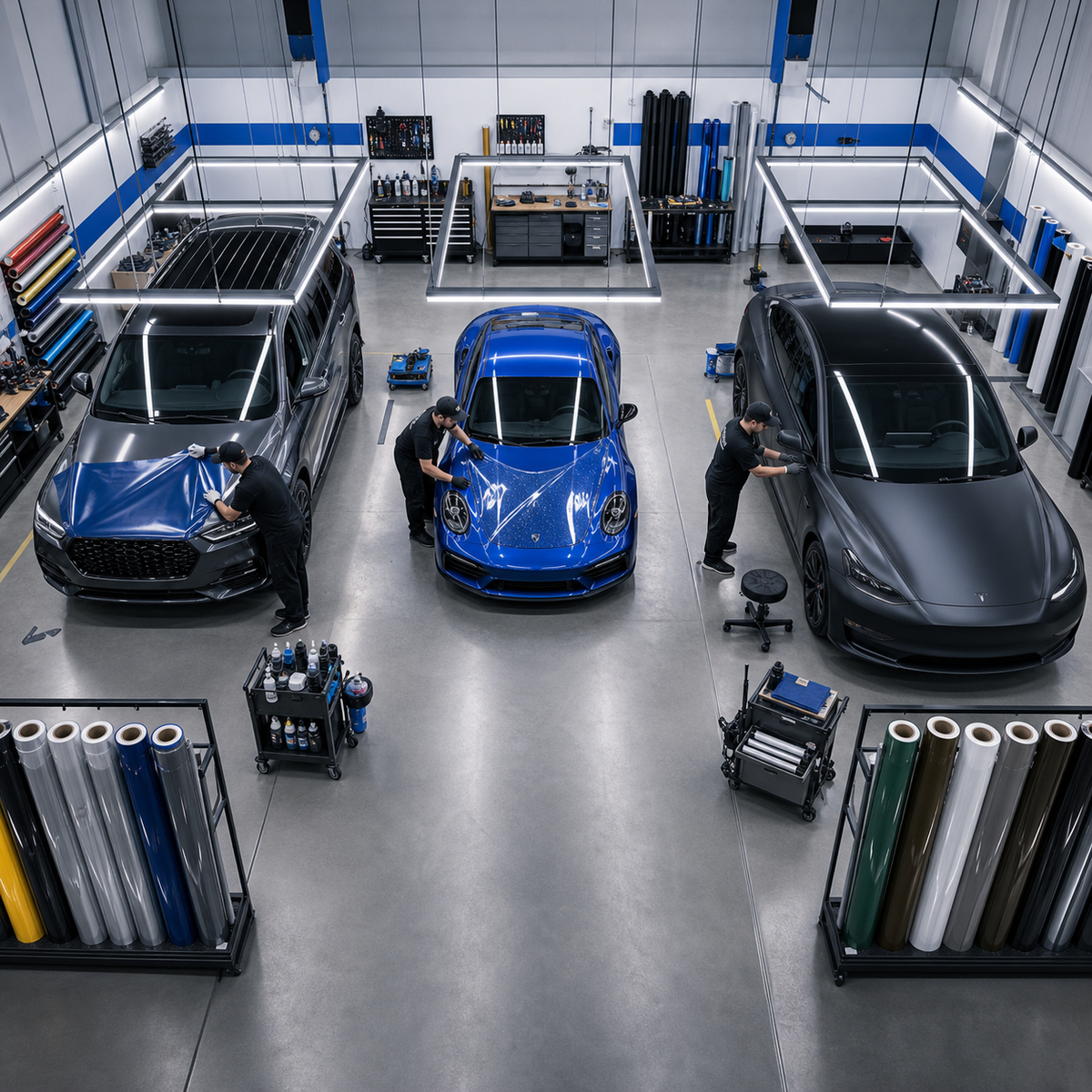
Satin vs matte vinyl wrap is one of the most common finish comparisons in vehicle wrapping — and when gloss is added to the mix, the decision becomes one of the most consequential aesthetic choices a vehicle owner or fleet operator will make. These three finish types look dramatically different on a vehicle, behave differently in service, require different maintenance approaches, and suit different vehicle types and applications in ways that are not always obvious from a sample card or a product photo.
The finish choice is not just about personal preference. It affects how visible fingerprints and water spots are in daily use, how easy the wrap is to maintain to a professional standard, how forgiving the installation process is for beginners and experienced installers alike, and how the vehicle's colour depth and visual presence change under different lighting conditions. Getting the finish choice wrong means living with a vehicle that requires more maintenance than expected, or that does not deliver the visual impact you planned.
This guide compares satin vs matte vinyl wrap vs gloss across 9 real, practical differences — with the specificity that makes this comparison genuinely useful for making a final decision rather than just reinforcing uncertainty.
Quick Reference: Gloss wrap delivers maximum colour depth and visual impact with straightforward maintenance — the traditional professional standard. Matte wrap offers a distinctive premium aesthetic with the trade-off of higher maintenance sensitivity. Satin occupies the middle ground — more depth than matte, less reflectivity than gloss, and the most forgiving maintenance profile of the three.
Satin vs Matte Vinyl Wrap vs Gloss: What Each Finish Actually Is
Before the comparison, it is worth understanding what creates each finish at the surface level — because the physics of how light interacts with each finish explains most of the practical differences that follow.
Gloss Vinyl Wrap
Gloss vinyl has a smooth, highly polished surface that reflects light in a single, specular direction — like a mirror. This specular reflection is what produces the deep, wet-look colour depth that gloss finish is known for. The smooth surface also means that any contaminant sitting on the wrap surface — water spots, fingerprints, bird droppings — is clearly visible because it disrupts the uniform reflective surface. Gloss wrap typically has a surface sheen measurement (gloss unit rating) above 85 GU, with premium products reaching 90–95 GU.
Matte Vinyl Wrap
Matte vinyl has a highly textured surface at the microscopic level — tiny peaks and valleys that scatter incoming light in multiple directions rather than reflecting it uniformly. This diffuse reflection eliminates specular highlights entirely, producing the flat, no-shine appearance that defines matte finish. Because light is scattered rather than reflected, matte surfaces appear to absorb light — giving colours a more subdued, pigment-rich character compared to the same colour in gloss. Matte wrap typically measures below 10 GU. The same textured surface that eliminates shine also traps contaminants more easily than gloss — the primary maintenance challenge of matte vinyl.
Satin Vinyl Wrap
Satin vinyl sits between gloss and matte with a surface texture that produces partial specular reflection alongside significant diffuse reflection. The result is a low-sheen, silk-like finish that has more visual depth than matte (some directional light reflection produces colour luminosity) but significantly less reflectivity than gloss. Satin wrap typically measures 15–40 GU. The partial texture of satin's surface makes it more forgiving than pure matte for fingerprints and water spots — contaminants are less trapped than on matte — while the reduced reflectivity compared to gloss means water spots and minor surface marks are less visually prominent than on a mirror-finish gloss surface.
The Finish Spectrum: Gloss (85–95 GU) → Satin (15–40 GU) → Matte (below 10 GU). The gloss unit rating is a direct measurement of specular reflectance — the higher the number, the more mirror-like the surface. Understanding where each finish sits on this spectrum explains most of the maintenance and visual differences in the comparison below.
Satin vs Matte Vinyl Wrap vs Gloss: Master Comparison Table
All 9 differences summarised before the detailed analysis:
|
Dimension |
Gloss |
Satin |
Matte |
|
Light reflection |
Specular — mirror-like, high shine |
Semi-specular — silk sheen, medium depth |
Diffuse — flat, no shine, pigment-rich |
|
Colour depth |
Maximum — deep, saturated, wet-look |
High — luminous without glare |
Moderate — subdued, absorbed appearance |
|
Fingerprint visibility |
High — marks show clearly on dark colours |
Low-Medium — partially visible |
Low — textured surface hides marks |
|
Water spot visibility |
High — spots very visible |
Medium — less visible than gloss |
Low-Medium — texture masks spots |
|
Maintenance effort |
Moderate — easy wipe but spots reappear |
Low — most forgiving of the three |
High — requires matte-safe products |
|
Installation forgiveness |
Low — squeegee marks visible |
Medium — most forgiving for installers |
Low — surface marks show on dark mattes |
|
Heat sensitivity |
Low — standard heat application |
Low-Medium — standard application |
Medium — overheating changes finish locally |
|
Fleet/commercial use |
Excellent — professional standard |
Very Good — premium fleet option |
Good — premium but higher maintenance |
|
Wax/polish compatibility |
Yes — standard wax and polish |
Limited — matte-safe products only |
No — wax permanently damages matte finish |
9 Real Differences: Satin vs Matte Vinyl Wrap vs Gloss in Detail
#1 Light Reflection and Visual Character → Best: Depends on desired aesthetic
The most fundamental difference between gloss, satin, and matte vinyl wrap is how each finish interacts with light — and this drives every visual difference between the three. Understanding the light physics helps you predict exactly how your vehicle will look across different environments and lighting conditions.
Gloss vinyl's specular reflection produces dramatic lighting effects — highlights and shadows change sharply as the viewer's angle or the light source moves, creating the dynamic, attention-commanding visual presence that makes gloss wraps so visible and impactful. This same reflectivity means the finish is highly sensitive to the quality and colour of ambient light: gloss wraps look stunning in direct sunlight or showroom lighting, and can look washed-out or dull in overcast, flat lighting conditions.
Matte vinyl's diffuse reflection produces an opposite visual character: the finish appears consistent across lighting conditions because it scatters light uniformly regardless of angle. This consistency is part of matte's premium aesthetic — the finish looks intentionally flat and controlled rather than reactive to its environment. Colours in matte appear saturated at the pigment level rather than luminous through reflection, giving dark colours especially (matte black, matte grey, matte dark blue) a sophisticated, high-fashion quality.
Satin vinyl produces the most versatile visual result: directional light creates subtle highlights that give the surface life and depth, while the reduced reflectivity compared to gloss means the finish remains attractive and consistent in lower-quality lighting. For vehicles that spend time across a range of environments and lighting conditions, satin's visual versatility is a genuine practical advantage over both gloss and matte.
#2 Colour Depth and Saturation → Best: Gloss — maximum colour impact; Matte — unique pigment quality
The same colour specification produces meaningfully different visual results across gloss, satin, and matte finishes — and understanding this helps prevent disappointment when a colour that looked compelling on a swatch appears different on a full vehicle.
Gloss vinyl delivers the highest perceived colour saturation for most colours. The specular reflection amplifies colour luminosity — light bounces off the surface and reaches the viewer with the full energy of the colour's wavelength, producing vivid, saturated hues. Red, blue, yellow, and white are particularly enhanced by gloss finish; these colours reach their most visually powerful expression in gloss.
Matte vinyl changes the quality of colour saturation rather than simply reducing it. Dark colours in matte — particularly black, dark grey, navy, and forest green — develop a depth and richness that is simply not achievable in gloss, because the absence of reflective highlights allows the eye to focus entirely on the colour's pigment quality rather than its surface reflectance. This is why matte black has become one of the most popular premium wrap choices: the finish delivers a visual quality that is genuinely different from gloss black, not merely less shiny.
Satin occupies a genuinely appealing middle position for most colour families: colours have more depth and dimension than matte (due to the partial directional reflection) while avoiding the mirror-like intensity of gloss. For metallic and pearlescent colour formulations, satin frequently produces the best overall result — the partial reflection activates the metallic or pearl particles in the pigment without the aggressive shine of a full gloss surface.
#3 Fingerprint and Mark Visibility → Best: Matte and Satin win — gloss shows every touch
In daily use, the visibility of fingerprints, smudges, and handling marks is one of the most practically significant differences between the three finish types — and it is a difference that owners experience every time they touch or clean the vehicle.
Gloss vinyl's mirror-smooth surface makes fingerprints and smudges immediately and clearly visible, particularly on dark colours. On gloss black, a single fingerprint from opening a door handle is visible from several metres away in direct sunlight. This does not mean gloss is impractical — the marks wipe away instantly with a clean microfibre — but on dark-coloured gloss wraps in daily use, keeping the vehicle looking pristine requires regular attention.
Matte vinyl's textured surface hides fingerprints remarkably well in comparison — the diffuse reflection masks the smear pattern of a fingerprint more effectively than the specular reflection of gloss. However, matte's texture creates a different challenge: when marks do become visible (from heavy contact or oily contaminants), they can be more difficult to remove because the contaminant embeds into the surface texture rather than sitting on top of a smooth surface.
Satin's partial texture is the most balanced performer for daily use: it hides most casual fingerprints better than gloss and is easier to clean than matte when marks do need attention. For fleet vehicles in regular service where vehicles are handled by multiple people daily, satin's daily-use maintenance profile is genuinely superior to both alternatives.
#4 Maintenance Requirements → Best: Satin is easiest; Matte requires dedicated care products
Maintenance is where the practical consequences of finish choice are most consistently experienced, and where the difference between satin vs matte vinyl wrap is most pronounced for daily drivers and fleet vehicles.
Gloss vinyl wrap maintenance is straightforward: wash with pH-neutral automotive shampoo, dry with clean microfibre, and apply vinyl-safe spray detailer for a clean finish. Standard automotive care products are generally compatible with gloss vinyl. Wax and paint sealant can be applied to gloss vinyl to add an extra layer of surface protection and water-beading performance. The maintenance process is familiar and accessible to anyone with basic vehicle care knowledge.
Matte vinyl requires a dedicated maintenance regime that is distinctly different from standard automotive care, and the consequences of using the wrong products are permanent and irreversible. Wax must never be applied to matte vinyl — the wax fills the surface texture responsible for the matte finish and creates permanent glossy patches that cannot be restored without replacing the affected film sections. Similarly, polishing compounds, silicone-based detailers, and many standard spray detailers will partially or fully gloss-up matte surfaces. Matte vinyl maintenance requires matte-specific care products: pH-neutral matte-safe shampoo, matte-specific spray detailer, and no wax or polish of any kind.
Satin vinyl sits between the two in maintenance requirements. Standard pH-neutral shampoo is appropriate for washing. Wax is not recommended (it will increase the surface sheen toward gloss) but accidental contact with mild wax is more recoverable than on matte — the effect is visible but typically less dramatic. Satin-safe spray detailers are preferred, and many products marketed for matte surfaces are also appropriate for satin. The maintenance window for satin vinyl is wider than matte, making it more suitable for fleet applications where vehicles may be washed by general staff rather than specialist detailers.
Fleet Maintenance Warning: For fleet vehicles washed at commercial wash facilities or by non-specialist staff, matte vinyl requires explicit maintenance protocols and product restrictions that must be communicated to every person involved in vehicle care. A single application of standard wax at a commercial wash facility can permanently gloss-patch a matte vinyl wrap, requiring section replacement. Satin vinyl's wider maintenance tolerance makes it a safer fleet specification where wash facility control is limited.
#5 Installation Forgiveness → Best: Satin most forgiving; Gloss and Matte both unforgiving in different ways
The finish type affects the installer's experience as much as the owner's, and understanding each finish's installation characteristics helps professional installers set appropriate expectations and pricing.
Gloss vinyl is unforgiving of squeegee technique — any variation in squeegee pressure, angle, or speed leaves a visible line in the surface that is immediately apparent on the high-reflectivity finish. Dust contamination under the film shows clearly. Panel edges must be immaculate. For experienced professional installers with consistent technique, gloss presents no specific difficulty. For beginners, gloss is one of the most revealing finishes for minor technique imperfections.
Matte vinyl is unforgiving in a different way — it is highly sensitive to heat gun misuse. Applying too much heat to a localised area of matte vinyl changes the surface texture in that area, creating a glossy patch that is permanently visible (the texture is physically altered, not just contaminated). Over-stretching matte vinyl on curves can also thin the surface texture and reduce its matte character in stretched areas. Matte vinyl installation requires lower heat gun temperatures and more controlled heat application than gloss or satin.
Satin vinyl is genuinely the most forgiving of the three for installation. Its partial surface texture masks minor squeegee lines better than gloss, and its heat sensitivity is lower than matte — slight overheating does not produce the dramatic texture-change failure mode that matte exhibits. For new installers, or for fleet programmes where installation consistency across multiple vehicles and installers is required, satin is the most reliably achievable finish across varying installer skill levels.
#6 UV Durability and Colour Stability Over Time → Best: Gloss holds colour longest; Matte shows fading earliest
All three finishes use the same UV stabiliser technology in professional cast vinyl formulations, and the base UV durability rating of 5–7 years applies to all three in the same film product range. However, how UV degradation manifests visually is meaningfully different across finishes.
Gloss vinyl's degradation under UV is most visible as a progressive reduction in surface gloss — the finish becomes less mirror-like and more hazy over time as UV affects the topcoat layer. This is a gradual, uniform change that typically becomes noticeable around year 4–5 on exposed horizontal surfaces. The colour itself remains relatively stable because the smooth surface protects the pigment layer from direct UV contact.
Matte vinyl's textured surface is more directly exposed to UV because the peaks of the surface texture are not protected by a uniform topcoat layer in the same way as gloss. As UV affects the surface, the texture can begin to flatten in the most-exposed areas — reducing the matte character of those sections. This selective UV effect on texture can create visible variations in finish character across the vehicle before overall colour fading becomes apparent.
Satin vinyl's UV degradation profile is between the two — gradual and relatively uniform, with the partial texture providing more UV exposure than gloss but less than matte. For long-term UV durability, gloss vinyl maintains its specification (complete colour depth and surface character) for the longest period of the three finishes, with satin second and matte third in terms of maintaining their original finish character through the full rated lifespan.
#7 Fleet and Commercial Suitability → Best: Gloss is the professional default; Satin is premium fleet alternative
For fleet operators specifying vinyl wrap across commercial vehicle programmes, finish choice has practical implications for brand consistency, maintenance feasibility, and long-term presentation quality that go beyond individual vehicle aesthetics.
Gloss vinyl is the established professional standard for commercial fleet livery. Its colour accuracy is most predictable across batches, its maintenance can be managed by general commercial wash facilities without specialist products, and its visual impact — essential for brand visibility on commercial vehicles in traffic — is maximised. Fleet programmes requiring Pantone or RAL colour accuracy for brand compliance specify gloss as the default because colour measurement and quality control processes are most reliable on specular surfaces.
Satin vinyl is an increasingly popular premium fleet option for commercial programmes where brand premium positioning is a priority — technology companies, premium service providers, and luxury goods logistics operators are drawn to satin's refined visual quality. The maintenance requirements are manageable for fleet operators with proper staff guidance, and satin's ability to differentiate a fleet from the conventional gloss-dominated commercial vehicle landscape has genuine brand value.
Matte vinyl is a viable fleet specification only when the fleet operator has full control over the vehicle maintenance programme — own-operated wash facilities with trained staff and matte-specific products, and no reliance on external wash facilities or general maintenance staff. For fleets with controlled maintenance environments (luxury automotive dealers, premium hospitality operators), matte can be successfully maintained to a consistently high standard. For fleets relying on general commercial wash facilities, matte's maintenance sensitivity creates unacceptable brand presentation risk.
#8 Scratch and Swirl Visibility in Service → Best: Matte most forgiving; Gloss shows every swirl
Washing-induced swirl marks — the fine circular scratches left by improper wash techniques, dirty wash mitts, or automatic car washes — are one of the most common maintenance challenges for wrapped vehicles. The three finishes respond very differently to swirl marks in service.
Gloss vinyl is the most vulnerable to swirl mark visibility. The mirror-smooth specular surface amplifies any surface irregularity — fine swirl marks that would be invisible on matte are clearly visible on dark gloss vinyl under direct sunlight or bright artificial lighting. Maintaining a swirl-free gloss vinyl wrap requires two-bucket wash technique, dedicated wash mitts, and avoidance of automatic car washes with brushes. For high-value personal vehicles with gloss wraps, this level of wash care is standard practice. For fleet vehicles, it is operationally challenging.
Matte vinyl's textured surface is the most swirl-resistant of the three — the diffuse reflection that makes matte's finish so distinctive also makes fine surface scratches virtually invisible. This is one of matte's underappreciated practical advantages for daily drivers: while the finish requires more care around chemical products, it is forgiving of the washing-induced surface abrasion that afflicts gloss vinyl owners. The trade-off is that when matte does develop visible scratches from significant contact damage, they are more difficult to polish out (polishing is not appropriate for matte surfaces).
Satin's partial texture makes it meaningfully more swirl-resistant than gloss while remaining easier to maintain than matte. For vehicles that receive general commercial washing rather than specialist detailing, satin provides a practical middle ground that maintains acceptable appearance without the strict wash protocol requirements of gloss or the product restriction requirements of matte.
#9 Cost and Availability → Best: Gloss is most affordable; Matte and Satin command a modest premium
For buyers comparing satin vs matte vinyl wrap vs gloss on total cost, the price differences are real but modest — and unlikely to be the deciding factor in most purchasing decisions.
Gloss vinyl wrap in standard colours is the most widely produced and most price-competitive wrap finish. The manufacturing process for gloss topcoat is the most established, production volumes are highest, and competition between suppliers at the professional cast vinyl level is strongest in the gloss segment. Professional cast gloss vinyl from premium brands typically runs $3–$8 per square metre at B2B pricing.
Matte and satin finishes typically carry a 10–25% price premium over comparable gloss vinyl. The textured topcoat formulation requires additional manufacturing process steps, and production volumes are lower than gloss. At B2B pricing, the per-vehicle material cost difference between gloss and matte or satin on a standard sedan is typically $100–$300 — a relatively minor factor compared to the installation labour cost that represents the larger portion of total wrap project cost.
Availability across the colour range also differs by finish: gloss vinyl is available in the widest colour selection from all major manufacturers. Matte and satin ranges are generally somewhat narrower — particularly for specialty colours beyond the standard black, white, grey, and primary colour palette. For fleet programmes requiring specific brand colours in matte or satin finish, confirming colour availability and batch consistency before specifying the finish is an important procurement step.
Highcool Finish Range: Highcool's commercial cast vinyl range covers gloss, satin, and matte finishes across our standard colour palette, with B2B pricing and batch colour consistency documentation available for all three finish types. For fleet programmes specifying non-standard colours in satin or matte, contact our B2B team at highcool.com to discuss colour availability and batch matching capability.
Satin vs Matte Vinyl Wrap vs Gloss: Which Should You Choose?
Use this decision matrix to match finish type to your specific application and priorities:
|
Application / Priority |
Best Finish |
Reason |
|
Maximum colour impact and visual presence |
Gloss |
Specular reflection delivers deepest colour depth and most attention-commanding finish |
|
Premium aesthetic with minimal maintenance |
Satin |
More visual depth than matte; more forgiving to maintain than both gloss and matte |
|
Distinctive flat, fashion-forward appearance |
Matte |
Diffuse reflection and pigment-quality colour unique to matte finish |
|
Fleet vehicles — commercial wash facilities |
Gloss or Satin |
Both tolerate general maintenance; matte requires specialist wash protocol |
|
Daily driver — fingerprint-tolerant finish |
Matte or Satin |
Both hide casual marks better than gloss on dark colours |
|
Beginner installer — most forgiving finish |
Satin |
Forgives squeegee technique better than gloss; less heat-sensitive than matte |
|
Dark colours (black, dark grey, navy) |
Matte or Satin |
Both deliver superior aesthetic to gloss on dark colours; matte especially distinctive |
|
Light colours (white, silver, light grey) |
Gloss or Satin |
Light colours benefit less from matte's depth effect; gloss and satin both excellent |
|
Metallic or pearl colours |
Satin |
Partial reflection activates metallic/pearl particles without aggressive gloss shine |
|
Long-term UV durability priority |
Gloss |
Smooth surface maintains colour and finish character longest under UV exposure |
|
Brand premium positioning in fleet |
Satin |
Differentiates fleet from gloss-standard competitors; manageable maintenance |
|
Resale value protection |
Gloss |
Most universally appealing finish for maximum resale market; easiest to assess condition |
Care Guide: Maintaining Each Finish to Professional Standard
Each finish requires a slightly different maintenance approach. Here is the essential care protocol for all three:
Gloss Vinyl Wrap Care
• Wash with pH-neutral automotive shampoo using two-bucket method
• Dry immediately after washing with clean microfibre to prevent water spots
• Apply vinyl-safe spray detailer or quick detailer for enhanced protection and water beading
• Standard automotive wax and paint sealant compatible — apply sparingly, avoid panel seams
• Avoid automatic car washes with rotating brushes — use touchless wash facilities if self-wash not possible
• For swirl removal: vinyl-safe machine polish at low speed with foam pad (test on inconspicuous area first)
Satin Vinyl Wrap Care
• Wash with pH-neutral matte-safe or satin-safe shampoo — avoid high-gloss shampoos
• Dry with clean microfibre — same protocol as gloss
• Use satin-safe spray detailer — many matte-specific products are also satin-compatible
• Avoid wax (will increase surface sheen toward gloss) — use vinyl sealant specifically labelled matte/satin-safe
• Avoid abrasive polishes — satin surface texture is part of the finish character
• Touchless car wash acceptable — avoid brush car washes as with all vinyl finishes
Matte Vinyl Wrap Care
• Wash by hand only with matte-specific pH-neutral shampoo — no automatic wash facilities
• Rinse thoroughly, dry immediately with clean microfibre — no wringing or circular wiping motions
• Use only matte-specific spray detailer — never standard detailer, wax, or silicone-based products
• Never apply wax, polish, or paint sealant — these permanently alter the matte surface texture
• For spot contamination (bird droppings, tree sap): soak with warm water before removal — never scrub dry
• Inspect annually for any glossy patches from accidental product contamination — section replacement may be required if affected area is significant
Highcool Maintenance Documentation: Highcool supplies detailed care guides for gloss, satin, and matte vinyl wrap to all B2B account holders, including recommended product lists and maintenance protocol templates for fleet operators. Contact highcool.com for technical documentation and B2B account setup.
Conclusion: Satin vs Matte Vinyl Wrap vs Gloss — The Right Choice
The satin vs matte vinyl wrap vs gloss comparison does not produce a single winner — it produces a clear best choice for each set of priorities and circumstances. Gloss delivers maximum colour impact, the widest maintenance compatibility, and the longest UV durability for finish character. Matte delivers a distinctive premium aesthetic on dark colours with the best swirl-mark resistance in service. Satin delivers the most balanced combination of visual depth, maintenance forgiveness, and installation reliability — making it the most versatile specification across the broadest range of vehicles and applications.
For most fleet operators and professional installers specifying wrap for commercial applications, gloss remains the reliable professional default. For premium brand positioning or owners who want visual differentiation from the conventional gloss-dominated wrap market, satin provides the best quality-to-maintainability trade-off. Matte is the specialist choice for owners who have the maintenance discipline and product knowledge to maintain it correctly — the result is genuinely striking, but the commitment is real.
At Highcool, our commercial cast vinyl range covers all three finishes with B2B pricing, batch colour consistency, and technical documentation for fleet and professional applications. Contact our team at highcool.com for samples, specifications, and volume pricing.
Explore gloss, satin, and matte vinyl wrap from Highcool's commercial range at highcool.com — B2B pricing, colour samples, and technical datasheets on request.
Frequently Asked Questions: Satin vs Matte Vinyl Wrap vs Gloss
Q: What is the difference between satin and matte vinyl wrap?
A: Satin and matte vinyl wrap both reduce surface reflectivity compared to gloss, but through different surface structures. Matte vinyl has a heavily textured surface that scatters all light diffusely, eliminating specular reflection entirely and producing a completely flat, no-shine finish. Satin vinyl has a lighter texture that allows partial specular reflection alongside diffuse reflection, producing a silk-like low-sheen finish with more colour depth than matte. In practical terms, satin is easier to maintain (wider product compatibility), more forgiving to install, and more visually versatile across lighting conditions. Matte delivers a more distinctive flat aesthetic on dark colours but requires dedicated matte-specific maintenance products.
Q: Is matte or gloss vinyl wrap harder to maintain?
A: Matte vinyl wrap is significantly harder to maintain than gloss. Gloss vinyl is compatible with standard automotive care products including wax, polish, and general detailers, and washing-induced marks can be addressed with standard detailing techniques. Matte vinyl requires matte-specific shampoo and detailer, cannot be waxed or polished under any circumstances (wax permanently damages the matte surface texture), and should be hand-washed rather than processed through automatic facilities. A single accidental application of standard wax to matte vinyl can create permanent glossy patches requiring section replacement. Satin vinyl has a maintenance profile closer to matte but with more tolerance for minor product errors.
Q: Does matte vinyl wrap scratch easily?
A: Matte vinyl wrap is actually more resistant to visible swirl marks and fine surface scratches than gloss vinyl, because its textured surface diffuses light in ways that make minor scratches invisible. However, matte vinyl is susceptible to a different type of damage: glossy patches from heat overexposure during installation, wax contact, or heavy abrasion that flattens the surface texture. These texture-change defects cannot be polished out as they can on gloss vinyl — they require section replacement. So while matte resists the type of scratches that afflict gloss vinyl, it is vulnerable to texture damage that gloss and satin are not.
Q: Is satin vinyl wrap more expensive than matte or gloss?
A: Matte and satin vinyl wrap typically cost 10–25% more than comparable gloss vinyl at the same quality tier. The textured topcoat formulation for both finishes requires additional manufacturing process steps and is produced in lower volumes than gloss, supporting a modest price premium. At B2B volume pricing, the material cost difference between gloss and matte or satin on a full vehicle installation is typically $100–$300 — a minor component of total project cost when installation labour is included. All three finishes are available across Highcool's commercial cast vinyl range; contact highcool.com for B2B pricing on your required volumes.
Q: Can you wax satin or matte vinyl wrap?
A: No — neither satin nor matte vinyl wrap should be waxed. Applying wax to matte vinyl fills the surface texture responsible for its flat finish and creates permanent glossy patches that cannot be reversed without replacing the film. The effect on satin vinyl is less dramatic but still visible — wax increases the surface sheen toward gloss, partially compromising the satin finish character. Both finishes should be protected with vinyl sealants specifically formulated as matte-safe or satin-safe, which provide protection and water beading without altering the surface finish. Only gloss vinyl wrap is compatible with standard automotive wax.
Q: Which vinyl wrap finish is best for a black car?
A: Matte black and satin black are both exceptionally popular choices for black vehicle wraps, and both deliver superior aesthetic results to gloss black in most contexts. Matte black produces a distinctive, absorbed, high-fashion appearance with virtually no reflective highlights — the premium look most associated with stealth-finish vehicle customisation. Satin black delivers a silk-like finish with subtle directional highlights that adds more visual depth and dimension than matte while retaining a refined, non-aggressive aesthetic. Gloss black is visually striking in perfect condition but shows every fingerprint, water spot, and swirl mark in daily use. For daily drivers in black, satin black is the most practical premium choice; for maximum visual impact in a controlled environment, gloss black; for the most distinctive flat aesthetic, matte black.
Resources & Related Reading
External Resources (DoFollow)
• Avery Dennison Graphics — Finish Type Technical Specifications: https://graphics.averydennison.com
• PDAA — Professional Decal Application Alliance: Installer Standards: https://pdaa.com
• 3M Automotive — Wrap Film Finish Range and Technical Documentation: https://www.3m.com/3M/en_US/graphics-signage-us/resources/
Related Highcool Guides
• Best Vinyl Wrap Brands in 2026: Top 8 Compared: https://highcool.com/blog/best-vinyl-wrap-brands-2026
• Vinyl Wrap Care & Maintenance Guide: https://highcool.com/blog/vinyl-wrap-care
• Does Vinyl Wrap Fade Over Time?: https://highcool.com/blog/vinyl-wrap-fading
• Cast vs Calendered Vinyl Wrap: 7 Critical Differences: https://highcool.com/blog/cast-vs-calendered-vinyl-wrap
• Highcool B2B Vinyl Wrap Product Range: https://highcool.com/products/vinyl-wrap


Share:
Windshield Repair Cost Prevention: 7 Powerful Ways Film Cuts Claims
How to Remove Vinyl Wrap Safely: A Complete Guide for Professionals & DIYers