
1. Executive Summary
Color Paint Protection Film (Color PPF) represents the next evolution of vehicle surface protection—combining true paint protection performance with integrated color and finish options. Unlike traditional vinyl wraps that prioritize appearance over durability, Color PPF is engineered to deliver impact resistance, self-healing capability, and long-term optical stability while providing a premium visual finish.
This white paper explains the technical foundation behind HIGHCOOL Color PPF, focusing on material selection, layer architecture, manufacturing controls, and performance benchmarks that matter to professional installers, distributors, and fleet customers. The objective is not to promote a product, but to clarify why Color PPF behaves differently from vinyl wrap—and why manufacturing discipline determines real-world results.
2. Market Context: Why Color PPF Exists
For decades, the market separated vehicle protection and styling into two categories:
-
PPF (Paint Protection Film): transparent, thick, protective, but visually invisible
-
Vinyl Wraps: thin, colorful, highly customizable, but minimally protective
As customer expectations evolved, demand emerged for a solution that could deliver both protection and design without compromise. Color PPF addresses this gap by embedding color and finish into a true TPU-based PPF platform, rather than adapting vinyl technology for protective use.
From a professional standpoint, this shift introduces new requirements in:
-
Material engineering
-
Coating uniformity
-
Optical control
-
Installation predictability
These requirements cannot be met through cosmetic film processes alone.
3. Core Material Science: TPU vs. PVC
3.1 Why TPU Is the Foundation of Real Protection
HIGHCOOL Color PPF is built on Thermoplastic Polyurethane (TPU)—the same elastomeric base used in advanced transparent PPF. TPU offers properties fundamentally different from PVC:
-
High elasticity and energy absorption
-
Excellent tear and puncture resistance
-
Shape recovery under thermal activation
-
Long-term chemical and UV stability
These properties allow TPU films to absorb impact energy from road debris and return to their original state—behavior that PVC cannot replicate.
3.2 Limitations of PVC-Based Vinyl Wraps
PVC (Polyvinyl Chloride), the base material of vinyl wraps, is optimized for:
-
Easy calendaring and stretching
-
Surface appearance and color variety
-
Low material cost
However, PVC lacks:
-
Elastic recovery
-
Impact resistance
-
Self-healing capability
From an engineering perspective, PVC is a decorative substrate, not a protective one.
4. Multi-Layer Architecture of HIGHCOOL Color PPF
HIGHCOOL Color PPF uses a multi-layer composite structure, designed to separate visual function from protective function.
Typical Layer Stack (Top → Bottom)
-
Advanced Clearcoat Layer
-
Scratch resistance
-
Chemical resistance
-
UV stability
-
Self-healing under heat
-
-
Color-Integrated TPU Core
-
Uniform pigmentation
-
Elastic impact absorption
-
Stable optical transmission
-
-
Functional TPU Base Layer
-
Structural integrity
-
Stress distribution
-
-
Pressure-Sensitive Acrylic Adhesive
-
Controlled tack
-
Clean removability
-
Minimal residue
-
-
Release Liner
Each layer is engineered independently, then bonded under controlled conditions to maintain consistency.
5. Thickness: The Hidden Performance Driver
Thickness is one of the most misunderstood parameters in surface films.
-
HIGHCOOL Color PPF: typically 150–200 μm
-
Typical Vinyl Wrap: 70–90 μm
This difference is not cosmetic. Increased thickness enables:
-
Physical barrier protection
-
Energy dispersion across the film
-
Reduced paint impact and chip penetration
From an installer’s perspective, thickness also affects:
-
Stretch behavior
-
Edge stability
-
Long-term adhesion under thermal cycling
6. Color Stability Without Dye Degradation
Traditional colored films often rely on organic dyes, which degrade under UV exposure and heat—leading to fading, discoloration, or purple shift.
HIGHCOOL Color PPF employs non-dyed color integration strategies within the TPU matrix, supported by:
-
UV inhibitors
-
Light-stable pigment systems
-
Controlled dispersion processes
This approach ensures:
-
Long-term color neutrality
-
Minimal hue shift over time
-
Predictable aging characteristics
7. Self-Healing Mechanism: Functional, Not Cosmetic
Self-healing in HIGHCOOL Color PPF is not a surface gimmick. It is a bulk material behavior driven by TPU elasticity and topcoat chemistry.
-
Light scratches disrupt polymer chains
-
Heat (sunlight or warm water) reactivates chain mobility
-
Surface returns to original smooth state
This process is repeatable and does not rely on coatings that wear off.
8. Manufacturing Control: Why Consistency Matters in B2B Supply
From a distributor or installer standpoint, batch consistency is often more important than peak lab performance.
HIGHCOOL operates as a factory-driven manufacturer, emphasizing:
-
Raw material traceability
-
Precision coating thickness control
-
Optical parameter testing (VLT, haze, gloss)
-
Batch-to-batch color consistency
-
Adhesive aging and peel-force validation
These controls reduce:
-
Installation variability
-
Rework rates
-
Customer complaints
-
Warranty exposure
9. Installation Behavior & Professional Handling
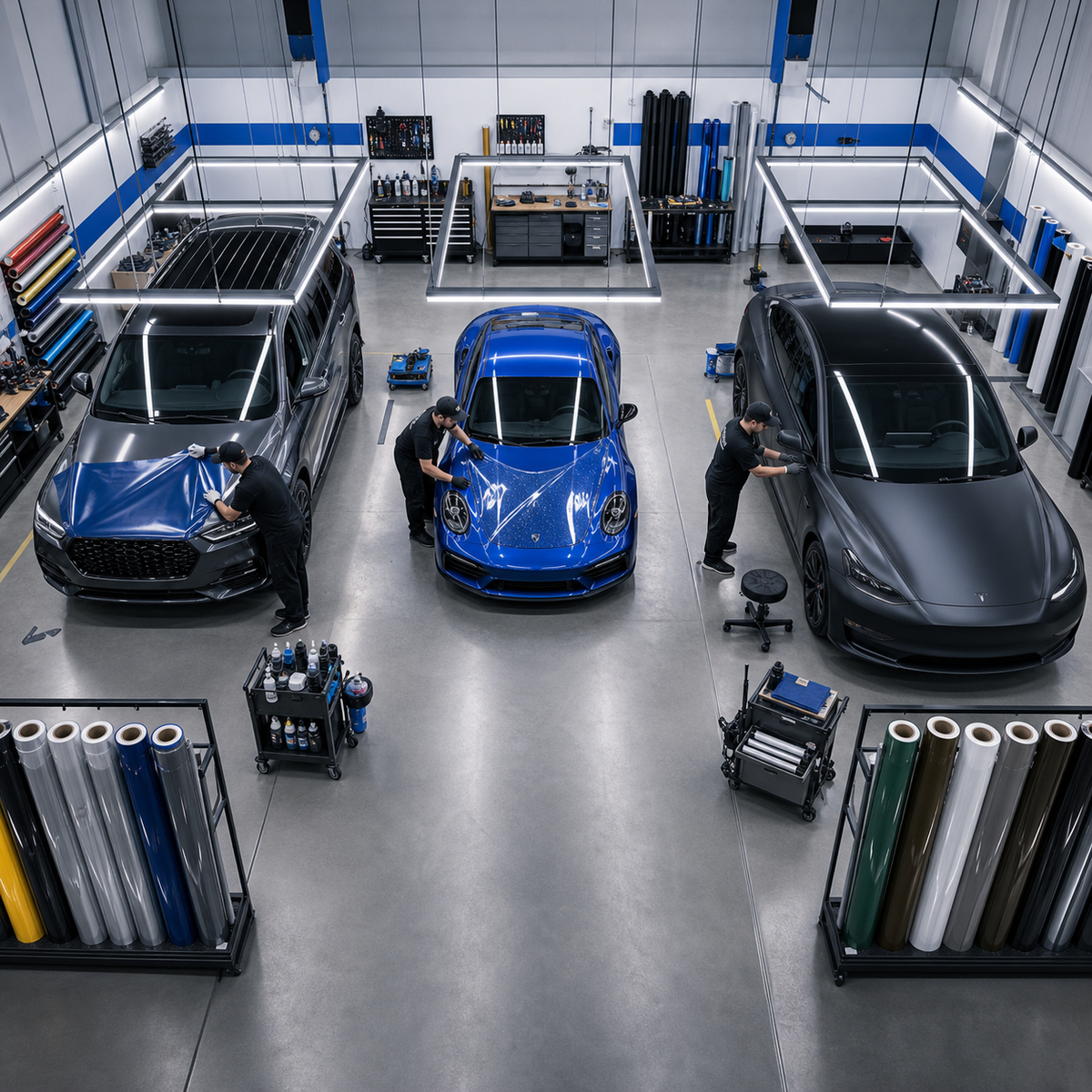
Color PPF behaves differently from vinyl during installation:
-
Higher elastic memory
-
More forgiving repositioning window
-
Reduced edge lifting under heat cycles
Professional installers benefit from:
-
Predictable stretch limits
-
Stable edges around complex contours
-
Reduced post-install callbacks
This predictability is critical for high-volume shops and multi-location distributors.
10. Longevity, Warranty & Lifecycle Value
With proper installation and care, HIGHCOOL Color PPF is engineered for:
-
7–10 years of service life
-
Resistance to yellowing, cracking, delamination
-
Stable adhesion without paint damage upon removal
From a business perspective, this translates to:
-
Fewer replacements
-
Higher customer satisfaction
-
Stronger lifetime value per vehicle
11. Color PPF vs. Vinyl Wrap: Engineering Comparison
| Parameter | HIGHCOOL Color PPF | Vinyl Wrap |
|---|---|---|
| Base Material | TPU | PVC |
| Thickness | 150–200 μm | 70–90 μm |
| Impact Protection | High | Minimal |
| Self-Healing | Yes | No |
| UV Stability | Excellent | Moderate |
| Color Shift Risk | Very Low | Medium–High |
| Typical Lifespan | 7–10 Years | 3–5 Years |
12. Strategic Use Cases
Color PPF is best suited for:
-
Long-term vehicle ownership
-
Premium and performance vehicles
-
Fleet or project vehicles requiring durability
-
Customers seeking both protection and design
Vinyl wraps remain suitable for:
-
Short-term promotions
-
Frequent color changes
-
Cost-driven cosmetic projects
13. Conclusion: Engineering First, Marketing Second
Color PPF is not “vinyl with protection added.” It is PPF with design integrated at the material level.
For professional installers and distributors, the value of HIGHCOOL Color PPF lies not in branding, but in:
-
Material predictability
-
Manufacturing discipline
-
Installation consistency
-
Long-term performance reliability
As the market moves beyond cosmetic differentiation, engineering-driven solutions will define the next generation of vehicle surface protection.
About HIGHCOOL
HIGHCOOL is an automotive film manufacturer specializing in TPU-based paint protection films and advanced window films, with a focus on material engineering, process control, and professional-grade performance. The company supplies global installer networks and B2B partners seeking consistent, scalable, and technically validated surface protection solutions.
For hands-on installation guidance, see our Color PPF installation guide.

Share:
Tree Sap, Bird Droppings and Bugs: Paint Protection Talking Points for Shops
Los Angeles Window Tint Laws (2025): A Guide for Tint Shops