

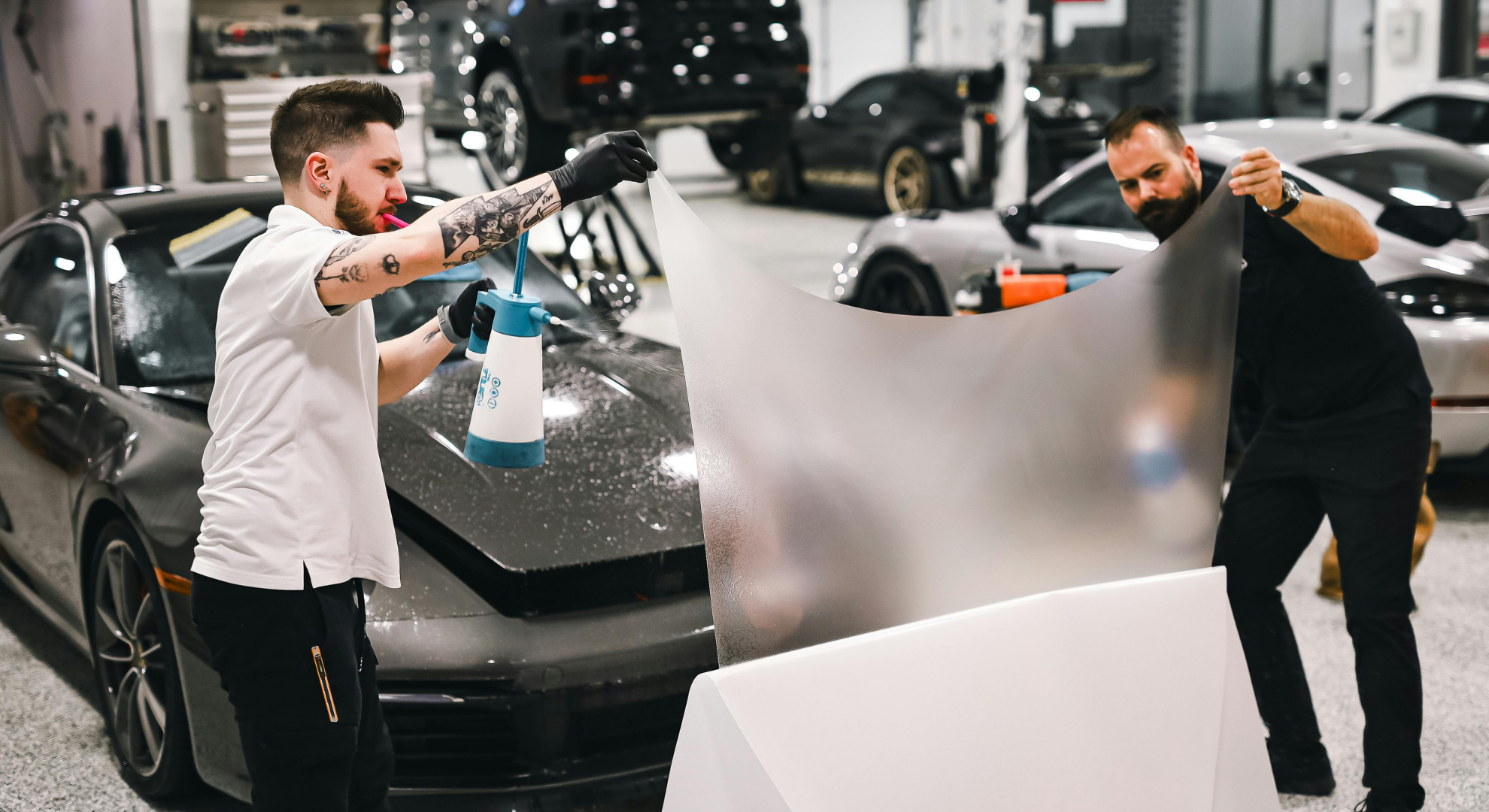
Yes, PPF can yellow in Arizona heat. Premium TPU PPF shows visible yellowing (over 3 delta E color shift) only after 4 to 6 years of direct desert sun, while budget PVC films yellow heavily by year 2. The difference comes down to UV stabilizers in the TPU formulation, not the climate itself.
This guide breaks down why TPU PPF yellows, how Arizona's UV load compares to moderate climates, the real timeline you can expect in Phoenix, which film grades hold up best in hot weather, and the maintenance habits that add 1 to 2 years of life.

The Short Answer for Arizona Drivers
Premium TPU PPF in Arizona shows minor yellowing (under 1.5 delta E) at year 3, moderate yellowing at year 5, and visible yellowing at year 6 to 7. Budget PVC films yellow visibly by year 2 regardless of the brand name on the box.
Arizona's UV index averages 8 to 11 from April through October, compared to 4 to 7 in Northeast states. The exposure dose runs roughly 50 percent higher per year, and that tracks almost directly with when yellowing starts.
Why TPU PPF Yellows
TPU yellows when long-chain polymer bonds break down under UV exposure, releasing molecules that absorb blue light and reflect yellow. Heat accelerates the reaction well above 100F ambient.
- UV-A (315 to 400 nm): The primary driver. It penetrates deep into TPU polymer chains, and Arizona delivers 40 to 60 percent more UV-A annually than moderate climates.
- Heat acceleration: Polymer breakdown roughly doubles per 18F rise. Phoenix summer dashboard temperatures past 160F stress film well beyond spec.
- Chemical exposure: Arizona dust plus monsoon rain leaves mineral deposits, and trapped contaminants accelerate yellowing in localized spots.
If you want the deeper material breakdown, see our what is paint protection film write-up on TPU chemistry, and why cheap film yellows for what goes wrong at the factory level. The short version for Arizona owners: yellowing is a chemistry problem, and the only counter is better UV stabilizers in the film itself.
Arizona vs Other US Climates
Annual UV dose in Phoenix is roughly 50 percent higher than Seattle and 30 percent higher than Atlanta. PPF lifespan reflects this gap almost linearly.
| City | UV Index (Summer Avg) | Sunny Days/Year | Premium TPU PPF Lifespan |
|---|---|---|---|
| Phoenix, AZ | 10 to 11 | 296 | 5 to 7 years |
| Las Vegas, NV | 10 to 11 | 294 | 5 to 7 years |
| Miami, FL | 9 to 10 | 248 | 6 to 8 years |
| Dallas, TX | 8 to 10 | 234 | 6 to 8 years |
| Los Angeles, CA | 7 to 9 | 284 | 7 to 9 years |
| Atlanta, GA | 7 to 9 | 220 | 7 to 9 years |
| Chicago, IL | 6 to 8 | 189 | 8 to 10 years |
| Seattle, WA | 5 to 7 | 152 | 9 to 12 years |
The Phoenix-to-Seattle gap is roughly 4 years on the same premium TPU film. Arizona owners should budget for replacement around year 6 rather than the headline warranty number.
Real Yellowing Timeline in Phoenix
On a daily-driven vehicle parked outdoors in Phoenix, premium TPU passes through four stages. Years 1 and 2 sit under 0.5 delta E, invisible to the naked eye, with self-healing fully functional. Year 3 lands between 0.5 and 1.5 delta E, measurable with an instrument but not visible against covered areas. Years 4 and 5 reach 1.5 to 3 delta E, visible only side by side with paint under a door handle. Past year 6 it clears 3 delta E and is visible at arm's length in bright light.
If you're tracking the year-5 question specifically, see our data on whether PPF is worth it after 5 years. For Phoenix owners, year-5 film is functionally still working but visually borderline. Most hot-state owners replace at year 6.
Best PPF Grades for Hot Weather
Films that survive hot-climate use share three properties: 8 mil thickness minimum, a UV stabilizer package rated for accelerated weathering tests, and a topcoat that blocks secondary UV exposure.
- 8-mil TPU minimum: Thinner 6-mil films yellow 1 to 2 years earlier in Arizona conditions.
- UV-stabilized formulations: Look for HALS (hindered amine light stabilizers) on the spec sheet. Films without them yellow noticeably faster.
- Hydrophobic topcoats: Add surface protection plus additional UV reflection, worth 1 to 2 years in hot climates.
Our own TPU PPF is built on Lubrizol, BASF, and Covestro base resins with a self-healing topcoat, and carries a 5 to 10 year no-yellowing warranty. Generic marketplace kits and unbranded shop films rarely publish a spec sheet at all. Get one before signing.
Common Buyer Mistakes in Hot States
Three mistakes drive most Arizona PPF regret. The cheapest quote almost always means 6-mil basic TPU, and by year 3 the difference shows. Skipping a hydrophobic topcoat gives up 1 to 2 years of film life. Parking outdoors when a garage exists lets dashboard temperatures past 160F heat-soak the surrounding panels.
Cheap film, no topcoat, and outdoor parking together can drop PPF life from 7 years to 3. Each mistake compounds the next.
Maintenance That Slows Yellowing
Three habits add 1 to 2 years in Arizona. Wash every two weeks from March through October with pH-neutral, PPF-safe soap and a microfiber mitt, which costs $40 to $80 a year in supplies. Get professional decontamination twice a year at $80 to $150 a session to strip bonded brake dust. Refresh the topcoat every 2 to 3 years for $300 to $600, which is the single most effective step.
Owners who follow this routine see year-7 film that looks like year-4 film on a neglected car. The yearly spend runs $400 to $700, less than premature replacement at year 5.
How to Choose an Arizona Installer
Ask how many Phoenix or Tucson installs the shop did in the past 12 months. Get the film thickness specified in the written quote, since 6-mil installs cost less but yellow sooner. Get the warranty in writing, and check whether it actually covers UV-related yellowing past year 5 rather than excluding it.
FAQ
How long does PPF last in Arizona?
Premium TPU lasts 5 to 7 years before showing visible yellowing, compared to 8 to 10 years in moderate climates. The difference comes from roughly 50 percent higher annual UV exposure and heat soak past 160F. Budget PVC films yellow within 2 years.
What is the best PPF for hot weather?
Look for 8-mil TPU minimum with HALS UV stabilizers and a hydrophobic topcoat. Avoid 6-mil films and any PVC kit. The premium over standard TPU pays for itself in hot states.
Can you fix yellowed PPF?
No. Yellowing is chemical degradation and cannot be reversed. Polishing removes surface contamination but does not reach the affected polymer layer. Once it passes 3 delta E, replacement is the only fix.
Sourcing UV-stabilized TPU for a hot-climate market? Ask for a free sample and a factory-direct quote.
Share:
Partial PPF vs Full Front PPF: Tesla Model 3 Cost
PPF Wholesale Supplier: How to Source TPU Film for Your Shop